
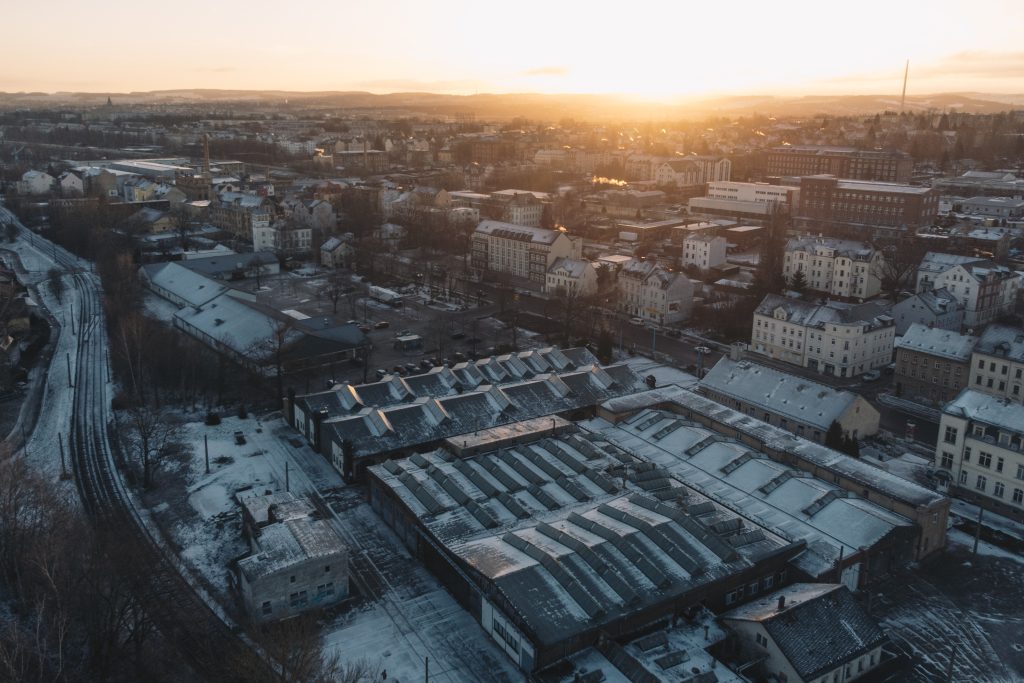
Der Garagen-Campus von oben

Roots and Development

The Kappel depot is the oldest site of public transport in Chemnitz – and a part of the city’s history. On April 22, 1880, the first horse-drawn tram line started operating from this location, which at the time featured a simple wooden carriage shed, four tracks, and a coachmen’s room.

With the introduction of electric tram operations in 1893, the area began to expand: new vehicle halls were built, including a large hall in 1908 that could house 64 tram cars, complemented by a main office and several communal buildings. The depot became the logistical heart of the city’s public transport network.

After World War II, the site was initially repaired and modernized. In the 1980s, the introduction of new Variobahn trams marked the end of the narrow-gauge era. Bus and tram operations were relocated, and the Kappel site was gradually phased out.

Some areas were leased out or dismantled – others remained unused. Yet part of the history lives on: in 1987, the “Tramway Friends Working Group” was founded to preserve vehicles and memories.

Today, a new place is emerging on this historic ground – the Garage-Campus: open to the future, rooted in the past.

The Site

The former tram depot in Kappel covers an impressive 30,000 square meters and consists of seven buildings and adjacent open spaces, offering a wide range of development opportunities. The site is easily accessible through two gates from Zwickauer Straße.

The entrance area is marked by a multi-story building that currently houses the Clock Museum and includes the historic social building. Toward the rear of the site lies the historic vehicle hall, now used as a tramway museum. With its 2,265 square meters, it provides a large space for exhibitions and events. Adjacent to it is the former main workshop, accompanied by a connected tram car hall and a dilapidated administration wing. This entire building complex spans 3,904 square meters and is in need of major renovation.

The site also includes the former smithy and the three-story coachmen’s house. Both buildings are part of the historic heritage, significantly in need of renovation, and offer great potential for future use.

In addition, a smaller operational building of 432 square meters is located off the main site. Some rooms are currently unused. Residential buildings and a car dealership are located nearby, shaping the surroundings of the Garage-Campus and creating an interesting mix of residential and commercial use.

"Track 0" at Garage-Campus
“Track 0” at Garage-Campus

Neighborhood

The Garage-Campus is located in the centrally situated district of Kappel, an area shaped by structural change between industrial history and a modern urban landscape. Kappel was once a major industrial location, but today, vacant and dilapidated buildings dominate the picture – especially along Zwickauer Straße. This road was once an important connection between Chemnitz and Zwickau but now faces urban planning challenges, such as oversized road spaces and heavy traffic.

In response, the City of Chemnitz has developed a framework plan for Zwickauer Straße to upgrade the area. The goal is to strengthen the local economy, improve residential quality, activate green open spaces, redesign the street, and promote innovative mobility solutions.

The Garage-Campus fits into this development concept by linking historical industrial monuments with new developments. Nearby are the former Braustolz brewery site, which is being transformed into a modern residential complex, and the former Wanderer-Werke factory premises. Since 2003, the Chemnitz Trade Fair has also been located in the area – a major venue for exhibitions, concerts, and conferences.

The neighboring Fettchemie site has been revitalized and now houses the Solaris Technology and Business Park. Kappel is also a green district where nature is gradually reclaiming abandoned industrial spaces. The Garage-Campus borders on allotment gardens and the Kappelbach stream, which, with its foot and cycle path, serves as a green link to the campus and holds great potential for further urban development.

Legal graffiti-action in the neighborhood
location